For thousands of years, humans have gazed at the night sky and wondered: Are we alone? Are there other worlds out there, orbiting distant stars, perhaps harboring life of their own? These questions, once the domain of philosophers and science fiction writers, have now become the focus of one of the most exciting fields of scientific research: exoplanet astronomy. The journey from ancient stargazing to modern planet hunting represents one of humanity’s greatest intellectual achievements, combining cutting-edge technology with age-old curiosity about our place in the cosmos.
An exoplanet is simply a planet that orbits a star other than our Sun. While the existence of such worlds was theorized for centuries, the first confirmed detection did not come until 1992, when astronomers discovered planets orbiting a pulsar, a type of dead star. The first planet found orbiting a sun-like star, 51 Pegasi b, was discovered in 1995, and it opened the floodgates for what would become a revolution in our understanding of the cosmos. This discovery, made by Swiss astronomers Michel Mayor and Didier Queloz, earned them the Nobel Prize in Physics in 2019 and fundamentally changed how we view planetary systems.
Today, thanks to NASA’s groundbreaking missions, we know of over 6,000 confirmed exoplanets, with thousands more candidates awaiting confirmation. These discoveries have transformed our view of the universe, revealing that planets are incredibly common, that our solar system is just one of countless configurations, and that potentially habitable worlds may be far more numerous than we ever imagined. Current estimates suggest that there are more planets than stars in our galaxy alone, with hundreds of billions of worlds potentially existing in the Milky Way.
This article explores the real discoveries made by NASA’s premier exoplanet-hunting missions: the Kepler Space Telescope, the Transiting Exoplanet Survey Satellite (TESS), and the James Webb Space Telescope (JWST). These missions have not only found thousands of alien worlds but have also begun to characterize their atmospheres, assess their potential habitability, and bring us closer than ever to answering the ultimate question of whether life exists beyond Earth. Each mission builds upon the successes of its predecessors, creating a comprehensive picture of the diversity and abundance of planets in our galaxy.
The significance of these discoveries extends far beyond pure science. Understanding exoplanets helps us appreciate the conditions that made life possible on Earth, provides context for our solar system’s formation and evolution, and may one day guide humanity’s expansion beyond our home planet. As we continue to explore the cosmic neighborhood, each new discovery brings us closer to understanding whether we are unique in the universe or part of a much larger community of living worlds.
When NASA launched the Kepler Space Telescope on March 6, 2009, few could have predicted how dramatically it would transform our understanding of planets beyond our solar system. Named after the German astronomer Johannes Kepler, who formulated the laws of planetary motion in the 17th century, this remarkable spacecraft was designed to answer one fundamental question: How common are Earth-like planets in our galaxy? This seemingly simple question had profound implications for our understanding of planetary formation, the potential for life elsewhere, and humanity’s place in the cosmos.
Kepler’s method was elegant in its simplicity yet revolutionary in its execution. The telescope stared continuously at a single patch of sky in the constellations Cygnus and Lyra, monitoring the brightness of approximately 150,000 stars with unprecedented precision. If a planet happened to pass in front of one of these stars from our perspective, it would cause a tiny, periodic dimming of the starlight, something Kepler was sensitive enough to detect. This method, known as the transit method, has become the most successful technique for finding exoplanets. The spacecraft could detect brightness changes as small as 20 parts per million, equivalent to noticing a flea passing in front of a bright light bulb.
The technical challenges of the Kepler mission were immense. The spacecraft needed to maintain incredibly stable pointing to detect the minute brightness variations caused by transiting planets. Any jitter or drift would swamp the signals the telescope was trying to detect. Kepler achieved this stability through a combination of precise attitude control, thermal management, and careful spacecraft design. The mission also required sophisticated data analysis techniques to separate true planetary signals from false positives caused by stellar variability, binary stars, and instrumental effects.
Over its nine-year mission, Kepler discovered more than 2,600 confirmed exoplanets, representing nearly half of all known alien worlds. But it was not just the quantity of discoveries that made Kepler revolutionary, it was the variety and significance of the planets it found. Kepler revealed a galaxy teeming with planetary diversity, showing us worlds that defied our expectations and challenged our theories of planetary formation. The mission discovered hot Jupiters that orbit their stars in mere days, super-Earths larger than our planet but smaller than Neptune, and miniature solar systems with multiple planets packed into orbits smaller than Mercury’s.
Among Kepler’s most important discoveries was Kepler-186f, announced in 2014. This planet, roughly the size of Earth, was the first validated Earth-size planet found orbiting in the habitable zone of another star, the region where temperatures might allow liquid water to exist on the surface. Located about 500 light-years from Earth, Kepler-186f orbits a red dwarf star and demonstrated that Earth-size planets in habitable zones do exist. The discovery was a watershed moment in exoplanet science, proving that potentially habitable worlds were not just theoretical possibilities but actual realities in our galaxy.
Another landmark discovery was the TRAPPIST-1 system, first identified by ground-based telescopes but extensively studied by Kepler and other space telescopes. This remarkable system, located just 40 light-years from Earth, contains seven Earth-size planets orbiting a cool red dwarf star. Three of these planets orbit within the habitable zone, making them prime candidates for follow-up studies searching for signs of life. The compact nature of this system, with all seven planets orbiting closer to their star than Mercury orbits our Sun, demonstrates how diverse planetary systems can be and challenges our assumptions about where habitable planets might exist.
Kepler also revealed that the galaxy is filled with planets that have no analog in our solar system. Hot Jupiters, gas giants orbiting incredibly close to their stars, were among the first exoplanets discovered and showed us that planetary systems can be dramatically different from our own. Mini-Neptunes, planets smaller than Neptune but larger than Earth, turned out to be the most common type of planet in the galaxy, even though our solar system has none. These sub-Neptune worlds, with their thick atmospheres and potential for habitability, have become a major focus of current exoplanet research.
Kepler ceased operations in October 2018 when it ran out of fuel, but its legacy continues to shape exoplanet science in profound ways. The vast amount of data collected by the spacecraft is still being analyzed, with new discoveries emerging years after the mission ended. Scientists using advanced machine learning algorithms have continued to find planet candidates hidden in Kepler’s data, demonstrating that this treasure trove of information will yield discoveries for years to come. Recent analyses using artificial intelligence have identified dozens of previously missed planets, showing that the full value of Kepler’s data has yet to be realized.
Perhaps Kepler’s most profound contribution was statistical. Before Kepler, we did not know whether planets were rare or common. Now we know that there are more planets than stars in our galaxy, with estimates suggesting hundreds of billions of planets in the Milky Way alone. This realization has fundamentally changed how we view our place in the cosmos and has energized the search for life beyond Earth. The mission demonstrated that small, rocky planets like Earth are common in the galaxy, with estimates suggesting that there may be tens of billions of Earth-size planets in the habitable zones of their stars in our galaxy alone.
The Kepler mission also pioneered many of the techniques and methods that are now standard in exoplanet research. The transit method, refined through Kepler’s observations, remains the most productive technique for finding exoplanets. The data processing pipelines developed for Kepler have been adapted for use with TESS and other missions. The statistical methods for validating planet candidates and estimating occurrence rates have become the gold standard for the field. In many ways, modern exoplanet science is built upon the foundations laid by Kepler.
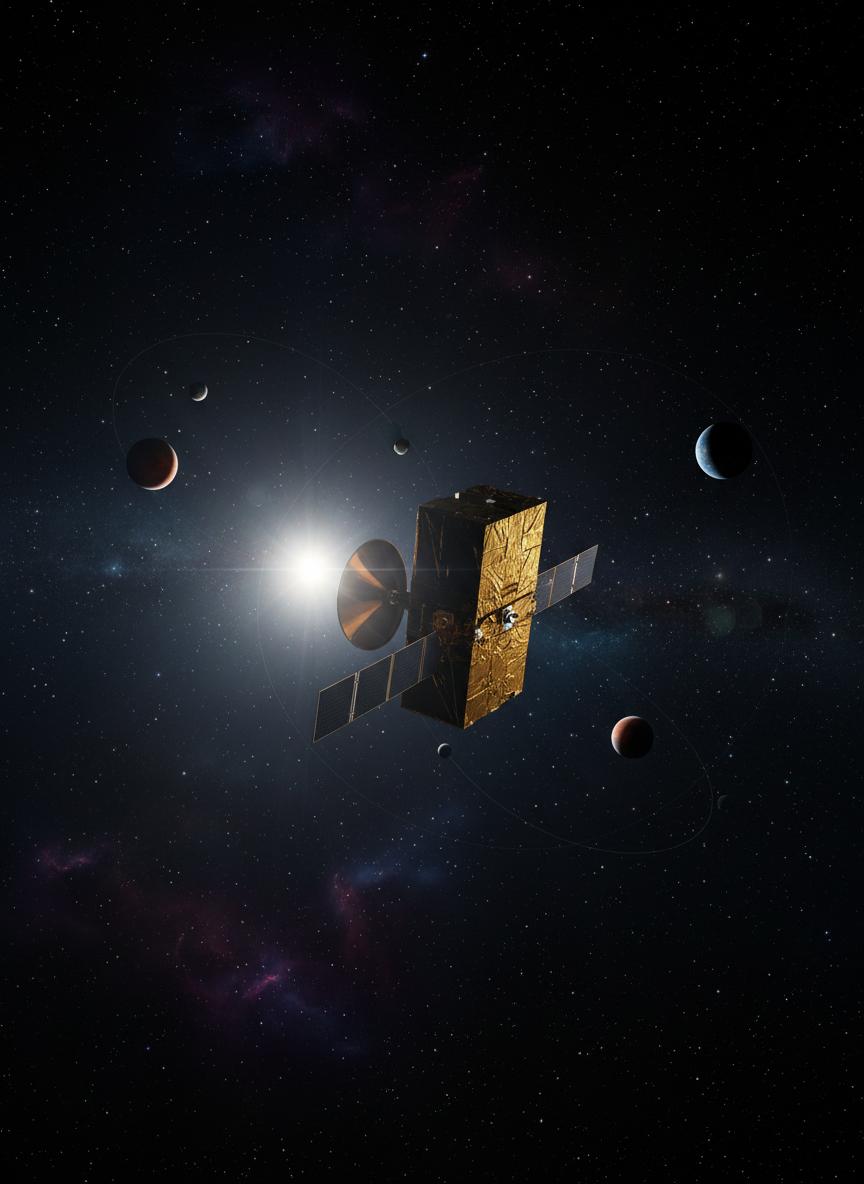
Figure 1: Artist’s impression of the Kepler Space Telescope discovering exoplanets
Following in Kepler’s footsteps, NASA launched the Transiting Exoplanet Survey Satellite, or TESS, on April 18, 2018. While Kepler focused on a small patch of sky to find distant planets, TESS was designed to survey the entire sky, searching for exoplanets around nearby, bright stars that would be ideal targets for follow-up observations. This complementary approach ensures that the most interesting planets discovered by TESS can be studied in detail by other telescopes, particularly the James Webb Space Telescope.
TESS represents a new phase in exoplanet hunting, one focused on finding targets for detailed characterization rather than simply maximizing the number of discoveries. By focusing on nearby, bright stars, TESS enables follow-up observations that can measure planetary masses through radial velocity techniques, characterize atmospheres through transmission spectroscopy, and even search for signs of life. This shift from discovery to characterization marks a maturation of the field and brings us closer to answering the ultimate question of whether life exists beyond Earth.
TESS operates differently from Kepler. Instead of staring at one patch of sky, TESS divides the sky into 26 sectors and observes each sector for about 27 days. This approach allows TESS to survey approximately 85 percent of the sky, focusing on the nearest and brightest stars. The mission is specifically designed to find planets that can be studied in detail by other telescopes, particularly the James Webb Space Telescope. TESS’s wide-field approach means it can find planets around stars throughout the solar neighborhood, creating a catalog of targets for future study.
The spacecraft carries four cameras, each with a field of view of 24 degrees by 24 degrees, giving TESS an enormous observing area. Each camera is equipped with a CCD detector sensitive to red and near-infrared light, optimized for detecting transits around the cool, red dwarf stars that are the most common type of star in the galaxy. These cameras monitor thousands of stars simultaneously, looking for the telltale dips in brightness that indicate a transiting planet. When TESS finds a promising candidate, ground-based telescopes and other space observatories can follow up to confirm the discovery and characterize the planet in detail.
TESS’s observing strategy is carefully designed to maximize scientific return. The spacecraft spends the first two years of its mission observing the southern sky, then switches to the northern sky for the next two years. This approach ensures complete sky coverage and allows for the detection of planets with a wide range of orbital periods. Planets with periods shorter than 27 days are detected during a single sector observation, while longer-period planets can be detected if they transit during multiple sectors or during TESS’s extended mission.
TESS has been remarkably successful, confirming over 765 exoplanets and identifying nearly 8,000 candidates as of early 2026. Among its most exciting discoveries are several Earth-size planets in habitable zones, planets orbiting binary star systems, and even planets with unusual properties that challenge our understanding of planetary formation. The mission has also discovered numerous super-Earths and mini-Neptunes, adding to our understanding of these common but poorly understood types of planets.
In 2025, TESS made headlines with the discovery of TOI-2267, a binary star system hosting three Earth-size planets. This was the first binary system known to have transiting planets around both of its stars, a configuration that astronomers had thought might be impossible due to gravitational instability. The discovery suggests that planets can form and survive in even more challenging environments than previously believed. The two stars in this system orbit each other at a distance of about 8 astronomical units, similar to the distance between Saturn and the Sun in our solar system.
Another remarkable TESS discovery was BD+05 4868 Ab, a planet so close to its star that it is literally disintegrating. This Mercury-size world orbits its star every 30.5 hours at a distance 20 times closer than Mercury orbits our Sun. The intense heat vaporizes material from the planet’s surface, creating a comet-like tail stretching over 5.6 million miles. Scientists estimate the planet loses the equivalent of Mount Everest’s worth of material with each orbit and could completely disappear within one to two million years. This discovery provides a rare opportunity to study the interior composition of a planet by analyzing the material in its tail.
TESS has also been instrumental in discovering planets using artificial intelligence. In 2026, researchers at the University of Warwick used a new AI pipeline called RAVEN to analyze TESS data, confirming 118 new planets and identifying over 2,000 high-quality candidates. This demonstrates how machine learning is accelerating the pace of discovery and helping us find planets that might have been missed by traditional search methods. The AI system was particularly effective at finding ultra-short-period planets that orbit their stars in less than 24 hours, as well as planets in the “Neptunian desert,” a region of parameter space where few planets are expected to exist.
Launched on December 25, 2021, the James Webb Space Telescope represents the next giant leap in exoplanet science. While Kepler and TESS were designed to find planets, JWST was built to study them in unprecedented detail. With its massive 6.5-meter primary mirror and sensitivity to infrared light, Webb can analyze the atmospheres of exoplanets, searching for the chemical signatures that might indicate habitability or even life. This capability transforms exoplanet science from a discovery-driven field to one focused on detailed characterization.
The James Webb Space Telescope is the result of an international collaboration between NASA, the European Space Agency, and the Canadian Space Agency. It represents the culmination of decades of technological development and scientific planning. Webb operates at the L2 Lagrange point, about 1.5 million kilometers from Earth, where it can maintain the extremely cold temperatures necessary for its infrared observations. The telescope’s sunshield, about the size of a tennis court, protects the sensitive instruments from the Sun’s heat, allowing them to detect the faint infrared signals from distant exoplanets.
When a planet transits its star, a small amount of starlight passes through the planet’s atmosphere. Different molecules in the atmosphere absorb different wavelengths of light, creating absorption features in the spectrum that Webb can detect. This technique, called transmission spectroscopy, allows scientists to determine what gases are present in an exoplanet’s atmosphere. By analyzing these spectra, astronomers can identify molecules like water vapor, carbon dioxide, methane, and oxygen, providing clues about a planet’s composition, temperature, and potential habitability.
In 2022, JWST made history by detecting carbon dioxide in the atmosphere of WASP-39b, a hot gas giant located 700 light-years from Earth. This was the first definitive detection of carbon dioxide in an exoplanet atmosphere, demonstrating Webb’s extraordinary capabilities. The observation revealed not just carbon dioxide but also water vapor, sodium, and potassium, giving scientists a detailed picture of the planet’s atmospheric composition. The detection was made with such clarity that researchers described the spectrum as looking like a textbook example of atmospheric transmission.
One of Webb’s most intriguing targets has been K2-18b, a sub-Neptune planet located about 120 light-years from Earth in the habitable zone of its star. In 2023 and again in 2025, Webb detected methane and carbon dioxide in the planet’s atmosphere, along with a possible hint of dimethyl sulfide, a molecule on Earth that is primarily produced by living organisms, particularly marine phytoplankton. While this detection requires confirmation and does not prove the existence of life, it has made K2-18b one of the most fascinating targets in the search for extraterrestrial life. The planet’s size and composition suggest it could be a “Hycean” world, a hypothetical type of planet with a hydrogen-rich atmosphere and a water ocean covering its surface.
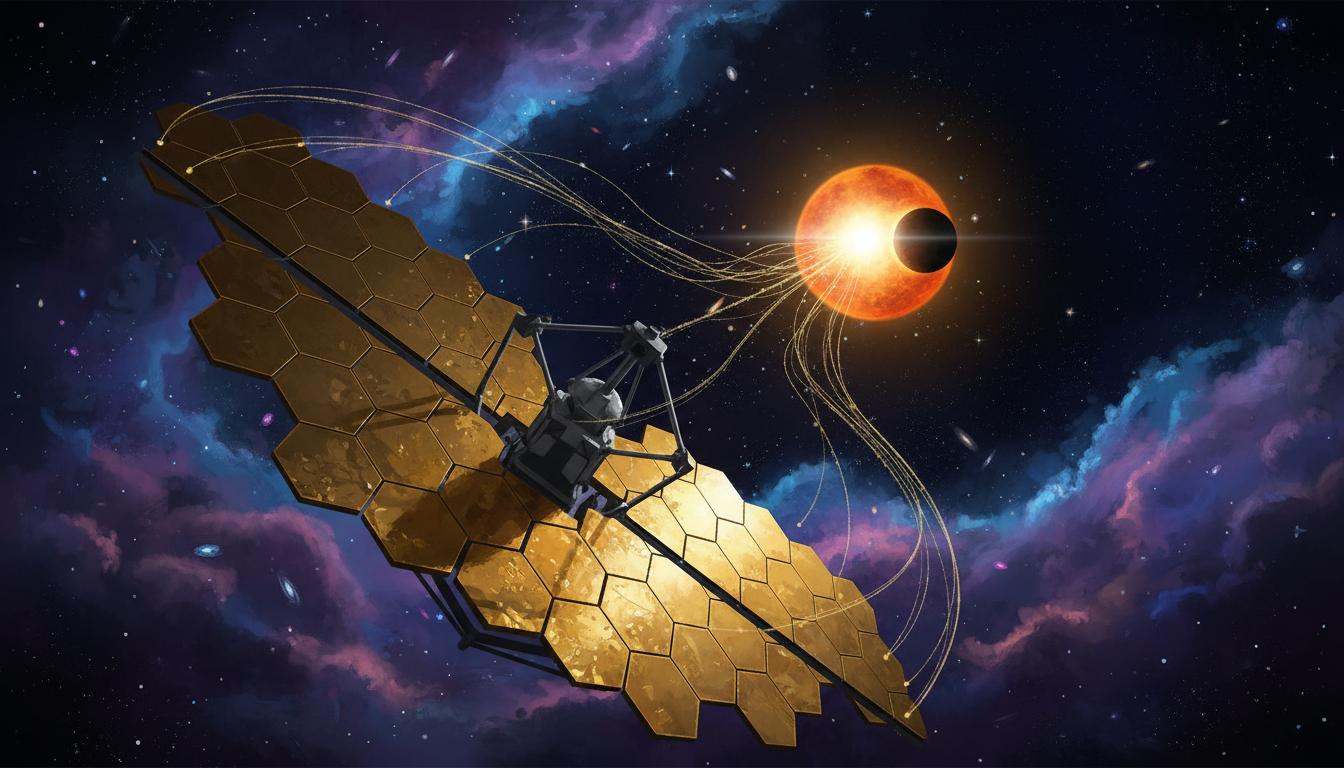
Figure 2: James Webb Space Telescope analyzing an exoplanet atmosphere during transit
Webb has also studied the TRAPPIST-1 system extensively, observing several of its seven Earth-size planets. These observations have begun to constrain the properties of their atmospheres, though the results have been mixed. Some data suggest that at least some of the TRAPPIST-1 planets may have thin atmospheres or none at all, while other observations hint at the presence of atmospheric gases. Continued study of this system remains a high priority for understanding the potential habitability of red dwarf planetary systems. The challenge is that these small, cool planets produce very small transit signals, requiring long observation times to build up sufficient signal-to-noise ratios.
Beyond transmission spectroscopy, Webb is also capable of thermal emission spectroscopy, which measures the infrared light emitted by a planet itself. This technique is particularly valuable for studying hot exoplanets that emit significant amounts of thermal radiation. By analyzing the thermal emission spectrum, scientists can determine a planet’s temperature structure, identify molecules in its atmosphere, and even map the distribution of heat across its surface. These observations provide insights into atmospheric circulation, heat transport, and the overall climate of alien worlds.
The search for habitable exoplanets, often called the search for “Earth 2.0,” is one of the most compelling goals of modern astronomy. But what makes a planet habitable? The traditional definition focuses on the habitable zone, the region around a star where temperatures are just right for liquid water to exist on a planet’s surface. However, habitability depends on many factors beyond just location, including atmospheric composition, magnetic field strength, geological activity, and the stability of the host star.
The concept of the habitable zone, also known as the Goldilocks zone, has been refined over decades of research. It is not a fixed region but depends on the properties of the host star. For hot, massive stars, the habitable zone is farther out, while for cool, dim stars like red dwarfs, it is much closer in. The boundaries of the habitable zone also depend on atmospheric properties. A planet with a thick, heat-trapping atmosphere might remain habitable at greater distances from its star, while a planet with a thin atmosphere might need to be closer to maintain liquid water on its surface.
In 2026, astronomers compiled a catalog of 45 Earth-like planets in habitable zones that represent the best candidates for supporting life. Among these are several well-known worlds, including Proxima Centauri b, the closest exoplanet to our solar system at just 4.2 light-years away. This Earth-mass planet orbits within the habitable zone of Proxima Centauri, a red dwarf star, though questions remain about whether the planet can maintain an atmosphere given the star’s frequent flares. Red dwarf stars are notoriously active, producing powerful flares that could strip away a planet’s atmosphere over time.
The TRAPPIST-1 planets, particularly TRAPPIST-1e, f, and g, remain among the most promising candidates. These Earth-size planets orbit a cool red dwarf star, and at least three of them are within or near the habitable zone. Recent observations suggest that TRAPPIST-1e may lack a substantial atmosphere, but the other planets in the system continue to be targets of intense study. The compact nature of this system makes it an ideal laboratory for studying planetary atmospheres and habitability, as multiple potentially habitable worlds can be observed with a single pointing of a telescope.
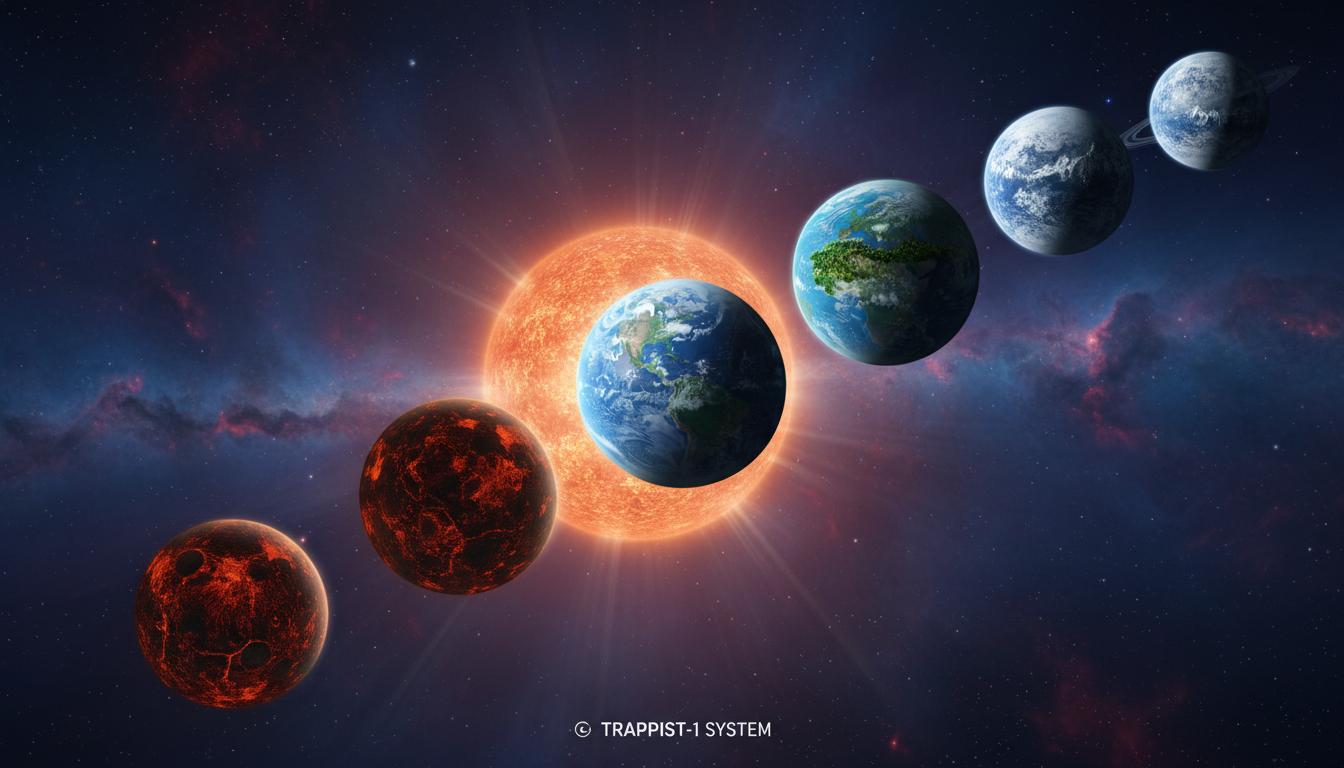
Figure 3: Artist’s impression of potentially habitable planets in the TRAPPIST-1 system
Another exciting candidate is LHS 1140b, a super-Earth located about 48 light-years away. This planet is about six times the mass of Earth and orbits within the habitable zone of a red dwarf star. Recent observations suggest it may have a thick atmosphere and possibly even liquid water on its surface, making it one of the best targets for atmospheric characterization with JWST. The planet’s large size means it could retain its atmosphere more effectively than smaller planets, providing better protection from stellar radiation.
Kepler-442b and Kepler-186f also rank among the top candidates. These planets receive levels of stellar radiation similar to Earth, making them potentially habitable if they have the right atmospheric conditions. The challenge is that these planets are too distant and their stars too faint for current telescopes to study their atmospheres in detail, so their true habitability remains unknown. Future missions, such as the Habitable Worlds Observatory, may be needed to characterize these distant worlds.
It is important to remember that being in the habitable zone does not guarantee habitability. A planet needs more than just the right temperature, it also needs a stable atmosphere, the right chemical composition, protection from harmful radiation, and a variety of other factors. Venus and Mars both orbit within or near the Sun’s habitable zone, yet one is a hellish inferno and the other is a frozen desert. Finding truly Earth-like conditions remains a significant challenge, requiring careful consideration of many factors beyond just orbital distance.
As remarkable as the discoveries of the past decade have been, the future of exoplanet science looks even brighter. Several new missions and instruments are scheduled to come online in the coming years, each promising to advance our understanding of alien worlds in new ways. From space-based observatories to ground-based extremely large telescopes, the tools for studying exoplanets are becoming more powerful and sophisticated, opening new windows on these distant worlds.
The Nancy Grace Roman Space Telescope, scheduled for launch in 2027, will carry a coronagraph that can block out the light from stars, allowing direct imaging of planets orbiting them. This will be a major step toward directly imaging Earth-like planets, something that current telescopes cannot do. Roman will also conduct the first microlensing survey from space, searching for planets in the outer reaches of planetary systems. Microlensing is particularly sensitive to planets at distances similar to Jupiter and Saturn in our solar system, complementing the transit method’s sensitivity to closer-in planets.
The European Space Agency’s PLATO mission, launching in 2026, is specifically designed to find and characterize Earth-sized planets around Sun-like stars. Unlike TESS, which observes each star for short periods, PLATO will stare at specific regions for years at a time, allowing it to detect planets with longer orbital periods, similar to Earth. PLATO’s long observation baseline will enable the detection of Earth-like planets in Earth-like orbits around Sun-like stars, addressing one of the key gaps in current exoplanet catalogs.
On the ground, a new generation of extremely large telescopes is under construction. The Extremely Large Telescope in Chile, with its 39-meter primary mirror, will be able to study the atmospheres of Earth-like planets in unprecedented detail. These ground-based observatories will complement space telescopes like JWST, providing different capabilities and helping to build a complete picture of exoplanet systems. The ELT’s adaptive optics system will correct for atmospheric turbulence, achieving resolutions comparable to space telescopes for some observations.
Looking further ahead, NASA is studying concepts for a Habitable Worlds Observatory, a space telescope specifically designed to search for signs of life on Earth-like planets. This mission, which could launch in the 2040s, would be capable of detecting biosignatures, atmospheric gases that could only be produced by living organisms, in the atmospheres of dozens of nearby Earth-like planets. The telescope would use advanced coronagraphs or starshades to block out the light from host stars, allowing direct imaging and spectroscopy of potentially habitable planets.
The ultimate goal of these missions is nothing less than finding evidence of life beyond Earth. Whether that life is simple bacteria or intelligent civilizations, its discovery would be one of the most profound events in human history. Thanks to the foundations laid by Kepler, TESS, and JWST, we are closer than ever to making that discovery. Each new mission builds upon the successes of its predecessors, creating a comprehensive toolkit for exploring distant worlds and searching for signs of life.
As we look to the future, we can reflect on how far we have come. Just three decades ago, we did not know if planets existed beyond our solar system. Today, we have discovered thousands of them, characterized their atmospheres, identified potentially habitable worlds, and developed the technology to search for signs of life. The question is no longer whether alien worlds exist, it is how many of them harbor life, and what that life might be like. The next generation of telescopes and missions will bring us closer to answering these profound questions.
NASA’s exoplanet missions have shown us that the universe is far more diverse and wondrous than we ever imagined. From hot Jupiters skimming the surfaces of their stars to frozen worlds at the edges of their systems, from planets with comet-like tails to potentially habitable Earth-like worlds, the galaxy is teeming with planets of every description. And somewhere out there, perhaps orbiting a nearby star, may be a world not so different from our own, waiting to be discovered. The search continues, driven by human curiosity and the enduring hope that we are not alone in the cosmos.
Key Discoveries Summary
The following table summarizes the major contributions of NASA’s exoplanet missions:
| Mission | Launch | Confirmed Planets | Key Contribution |
|---|---|---|---|
| Kepler | 2009 | 2,783 | First Earth-size habitable zone planet |
| K2 | 2014 | 549 | Extended mission, diverse targets |
| TESS | 2018 | 765+ | All-sky survey, nearby targets |
| JWST | 2021 | N/A | Atmospheric characterization |