When we think about America, we envision the world’s largest economy, cutting-edge technology, and advanced medical facilities. But did you know that even treating a simple fever in America can be financially devastating for an average person?
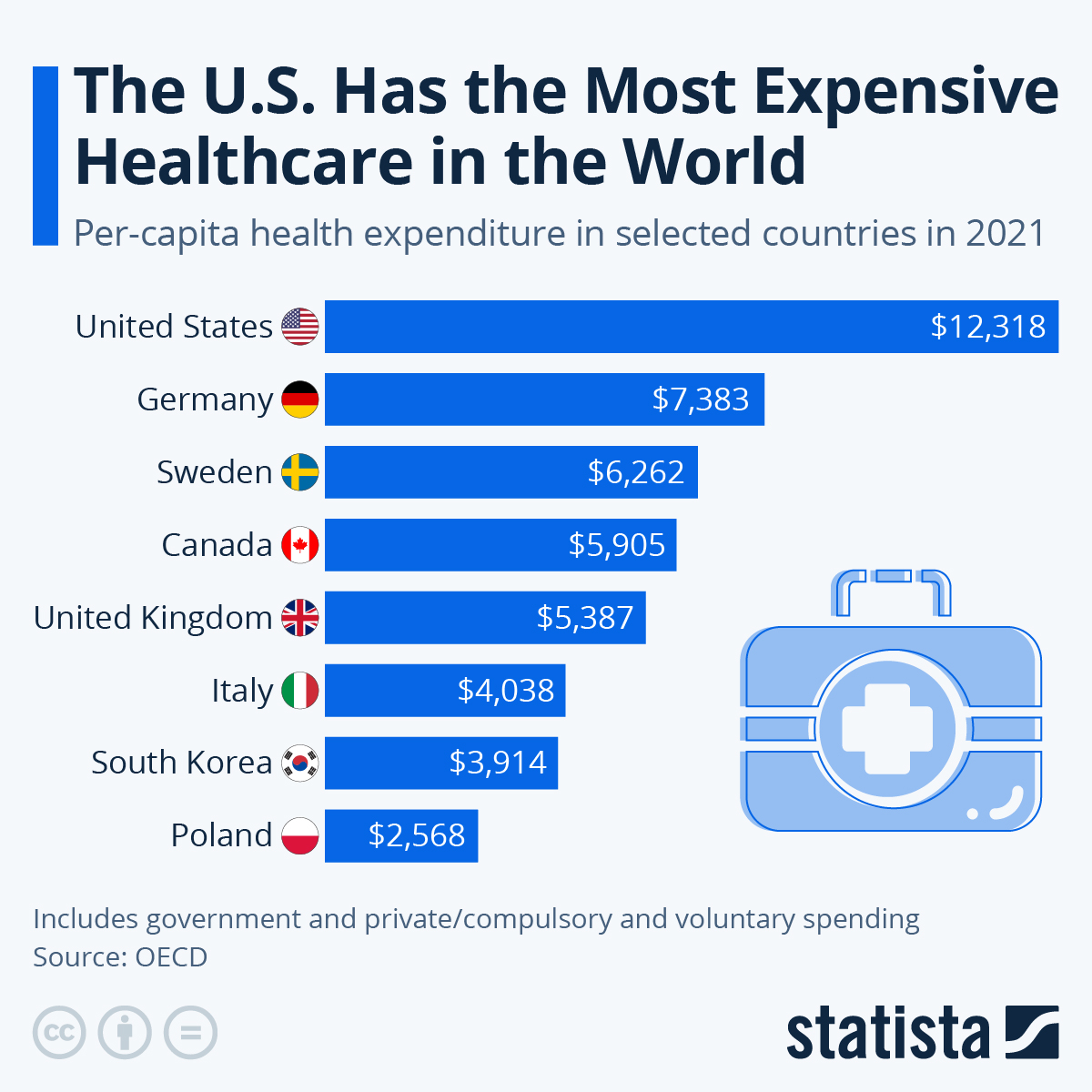
According to 2023 data, America spent $4.87 trillion on healthcare. This amounts to $14,570 per person (approximately $14,570 USD). This figure is nearly double that of any other developed country. In Germany, the expenditure is only $7,383, in Canada $5,905, and in the UK $5,387 per person.
But the most shocking fact is that despite spending so much, America’s health outcomes are not better than other developed countries. In life expectancy, infant mortality rates, and many other health indicators, America lags behind. So the question arises – why is healthcare so expensive in America?
Administrative Costs – The Price of Complexity
The Insurance Maze
Understanding the American healthcare system is no less than solving a puzzle. Here, private insurance companies, employer-sponsored plans, Medicare (for seniors), Medicaid (for the poor), and many other programs work simultaneously. This means every hospital and doctor must understand all these different insurance plans and bill accordingly.
What does this cost? – In America, $1,055 per person is spent on administrative costs – In other developed countries, this averages only $194 – This means administrative costs in America are 5 times higher!
The Complex Billing and Claims System
When a patient goes to a hospital, many employees are solely dedicated to processing insurance claims. Separate codes are created for every small service, negotiations happen with insurance companies, and sometimes claims are denied, forcing the entire process to start over.
Example: Even for a simple X-ray, the hospital must send a multi-page claim to the insurance company, including specific codes, doctor’s notes, and other documents. This process can take weeks.
No National Price Controls
Market-Based Pricing
In most developed countries, the government sets prices for healthcare services and medications. But this is not the case in America. Here, hospitals, doctors, and pharmaceutical companies set their own prices.
What is the result? – The price of an MRI scan in the same city can range from $400 to $4,000 – The same medication costs different prices at different pharmacies – Patients have no idea how much they will be charged
The Difference Between Medicare and Private Insurance
The US government pays for healthcare through Medicare and Medicaid, but these rates are limited by law. Hospitals claim they lose money at these rates and make up for it by charging privately insured patients more.
Example: – Average cost of hospital admission (private insurance): $28,038 – Amount paid by Medicare: approximately $11,000 – Patient’s out-of-pocket expense: $4,355 (maximum limit)
This means private insurance companies pay approximately 2.5 times more!
Skyrocketing Drug Prices
No Price Negotiation
In America, the federal government could not negotiate prices with pharmaceutical companies – this was a unique situation that changed recently with the 2022 “Inflation Reduction Act.” This meant pharmaceutical companies could charge whatever they wanted.
Some examples: – Insulin: The price of insulin in America is several times higher than in Canada or Europe – Cancer drugs: Spending on cancer drugs increased from $65 billion to $99 billion between 2019 and 2023 – GLP-1 drugs (for obesity): Spending on these increased from $14 billion to $71 billion between 2018 and 2023
The Influence of Pharmaceutical Lobbying
Pharmaceutical companies are among the most powerful lobbying groups in American politics. They make large donations to election campaigns and influence lawmakers to protect their interests.
Fee-for-Service Model – More Treatment, More Profit
Payment for Services Rendered
The American healthcare system operates on a “fee-for-service” model. This means doctors and hospitals are paid separately for every service, every test, and every procedure.
What is the problem with this? – The more tests, the more money – The more procedures, the more earnings – Less accountability for outcomes, more focus on quantity of services
Unnecessary Tests and Procedures
Studies have shown that at least 25% of healthcare spending in America can be considered waste. This includes unnecessary tests, procedures, and administrative costs.
High Salaries for Doctors and Specialists
Highest Paid in the World
American doctors and specialists are among the highest earners in the world.
Comparison: – Average salary of a general physician in America: $218,173 (approximately 1.8 crore rupees) – In other developed countries: $86,607 – $154,126 (70 lakh to 1.3 crore rupees)
Emphasis on Specialization
The American system places more emphasis on specialization than primary care. Specialist doctors earn much more than general practitioners, which increases healthcare costs.
Defensive Medicine – Fear of Lawsuits
Fear of Medical Malpractice
The risk of medical malpractice lawsuits in America is very high. Doctors often order unnecessary tests to protect themselves from potential lawsuits in the future.
The cost of this: – Annual spending on defensive medicine: approximately $45.6 billion – Total cost of medical liability: $55.6 billion per year
Price Opacity – No One Knows the Cost
No Clear Price List
Healthcare prices in America are often kept secret. Patients have no idea how much their treatment will cost.
Statistics: – Only 1 in 20 Americans know what healthcare will cost – The price of the same service in the same city can vary by thousands of dollars – Hospitals often charge different prices to different insurance companies
Lack of Competition
When patients don’t have price information, they cannot compare. This allows hospitals and doctors to charge higher prices without fear.
Hospital Mergers and Monopolies
Decreasing Competition
Between 1998 and 2023, more than 2,000 hospital mergers occurred in America. When small hospitals become part of large chains, competition decreases and prices rise.
According to studies: – Mergers can increase hospital prices by 5% or more – In some cities, one or two hospital chains dominate the entire market – This reduces options for patients
Power of Large Hospital Systems
Large hospital systems can negotiate better rates with insurance companies because they have more market power. This further increases prices.
Burden of Chronic Diseases
Epidemic of Chronic Conditions
In America, approximately 60% of people suffer from some chronic disease. These include diabetes, heart disease, and obesity.
Cost analysis: – Treatment of chronic diseases accounts for 90% of the country’s healthcare spending – This amounts to approximately $4.9 trillion per year – Many of these diseases could be prevented through lifestyle changes
Less Focus on Prevention
The American system focuses more on treatment than prevention. Compared to other countries, America spends very little on public health and prevention programs.
Aging Population
Retirement of the Baby Boomer Generation
America’s population is now the oldest it has ever been and is getting older. The “Baby Boomer” generation (born 1946-1964) is now retiring and needs more healthcare services.
Expenditure by age: – Ages 19-44: average $6,669 per person – Ages 65-84: average $20,503 per person – Ages 85+: average $35,995 per person
Pressure on Medicare
As more people join Medicare (for those 65+), government spending increases. Between 2014 and 2023, government healthcare spending grew from $1.36 trillion to $2.33 trillion.
New Technology and Treatments
Rapid Adoption of Expensive Technology
In America, new and expensive medical technology is adopted very quickly. MRI machines, robotic surgery, and new drugs – all of these are very expensive.
Examples: – MRI scan: Private insurance $1,311, Medicare only $269 – Robotic surgery: Several times more expensive than traditional surgery – New cancer drugs: $50,000 – $100,000 or more per year
No Cost-Effectiveness Assessment
In other countries, before adopting new technology or drugs, it is assessed whether it is cost-effective. In America, there is no such assessment – if something is available, it is used.
Growing Influence of Private Equity
Profit-Centered Approach
In recent years, private equity firms have started buying hospitals, nursing homes, and other healthcare providers. These firms’ main goal is to make profit, not patient care.
Results: – Staff reductions – Reduced services – Price increases – Aggressive billing practices
Tax Benefits and Employer-Based Insurance
Legacy of World War II
Employer-based health insurance in America began during World War II. At that time, there were wage controls, so companies attracted employees by offering health benefits. In 1954, Congress made these benefits tax-free.
The impact of this: – This tax break is worth $487 billion annually – It is the largest tax break in the entire tax code – It strengthened employer-based insurance, which is a fragmented system
The Illusion of “Free” Healthcare
When employees feel their insurance is “free” (because it doesn’t come directly out of their paycheck), they use more healthcare services. This increases demand and raises prices.
Rising Insurance Premiums
Increasing Burden on Families
In 2024, the average health insurance premium for a family was $25,572. This includes contributions from both employer and employee. Since 2014, this premium has increased by 50%.
Direct impact on patients: – Average out-of-pocket expense per person was $1,425 in 2022 – In the United Kingdom, it was only $764 – Many people have insurance but cannot use it because deductibles are too high
What is the Impact on Patients?
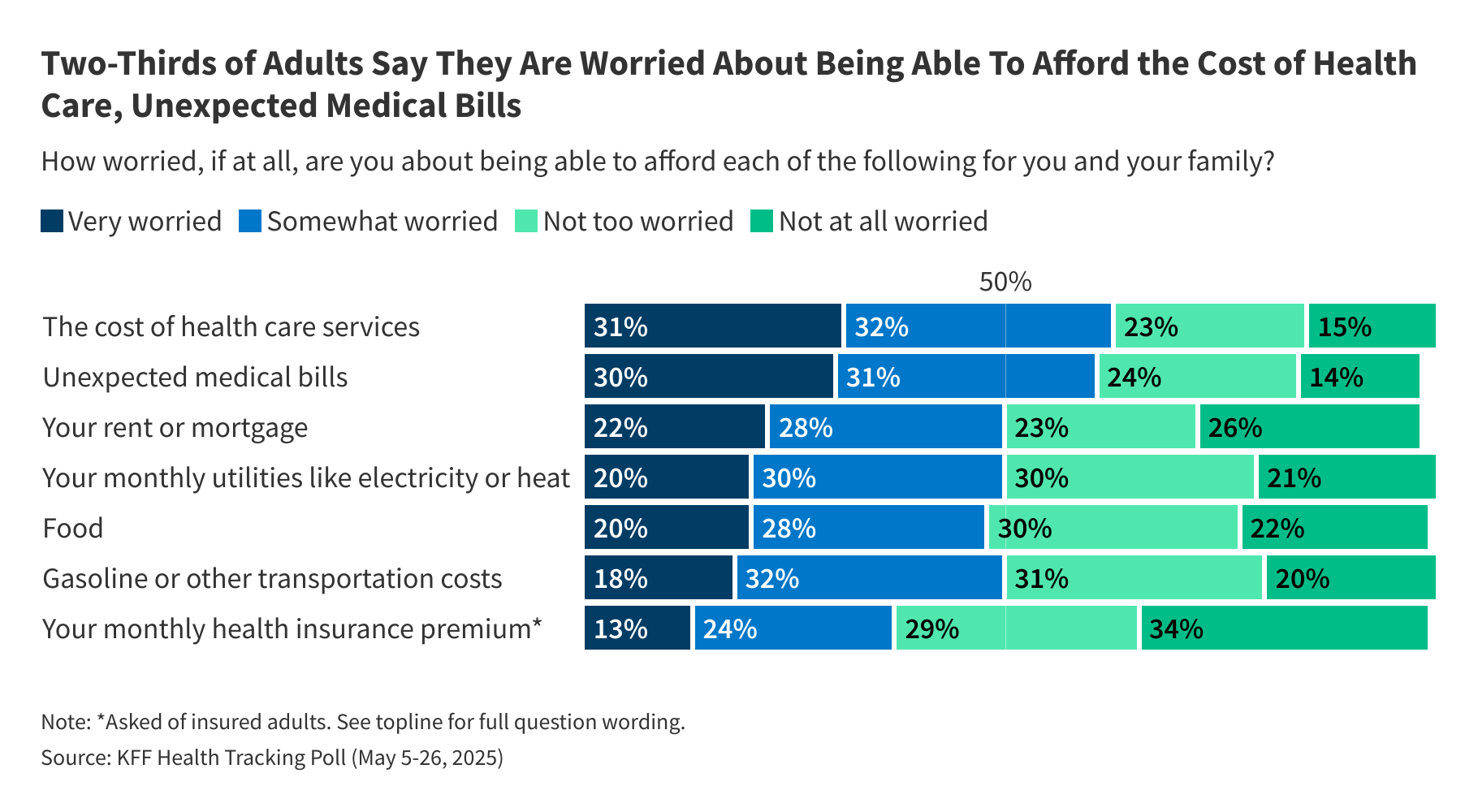
Americans’ Healthcare Concerns
Image: Two-thirds of adults say they are worried about being able to afford the cost of healthcare and unexpected medical bills (Source: KFF)
Financial Crisis
Medical bills are a common cause of bankruptcy for people in America. Studies have shown that 13.4% of Americans know a friend or family member who died because they could not afford medical treatment.
Delayed Care
Many Americans cannot even get necessary care because they cannot afford it. Surveys have shown that more than one-third of adults are “very worried” about healthcare costs.
Inequality
Low-income and non-white Americans are affected more: – Income under $40,000: 18.5% did not receive care – Income over $100,000: only 9.1% did not receive care – Non-white Americans: 20.3% affected – White Americans: only 9.6% affected
What Could Be the Solutions?
Administrative Simplification
The billing and claims process should be simplified. There should be an integrated system where all insurance companies use the same process.
Price Transparency
All hospitals and doctors should publish their prices publicly so patients can compare and make informed decisions.
Drug Price Negotiation
The government should be given the power to negotiate prices with pharmaceutical companies, as started with the recent “Inflation Reduction Act.”
Value-Based Care
The “fee-for-service” model should be changed to “value-based care,” where doctors and hospitals are paid based on patient outcomes.
Promoting Competition
There should be strict control on hospital mergers and strict enforcement of antitrust laws.
Focus on Prevention
More investment should be made in public health programs to prevent chronic diseases.
Conclusion: The Simple Essence of a Complex Problem
Healthcare is so expensive in America because:
- Administrative Complexity – Too many insurance programs and paperwork
- No Price Controls – Hospitals and pharmaceutical companies set their own prices
- Expensive Drugs – No collective negotiation
- Fee-for-Service Model – More treatment, more money
- High Salaries – Doctors earn the most in the world
- Price Opacity – Patients don’t even know
- Hospital Mergers – Less competition, higher prices
- Chronic Diseases – More focus on treatment, less on prevention
- Aging Population – More seniors, more spending
- New Technology – Rapid use of expensive technology
This is not a single problem with a simple solution. It is a structural problem resulting from decades of wrong policies, political gridlock, and the influence of special interest groups.
Until these root causes are understood and addressed, the American healthcare system will remain the most expensive in the world – and millions of Americans will continue to pay the price with their wallets and their health.
References and Sources
- Cato Institute – “Why Healthcare Is So Expensive in America”
- Washington Post – “Why is health care getting more costly?”
- University of Michigan – “Why Healthcare Is So Expensive in the U.S.”
- The Conversation – “Why is US health care still the most expensive”
- USA Today – “Why Americans pay so much more for health care”
- PMC – “The High Cost of American Health Care”
- KFF (Kaiser Family Foundation) – Various Reports
- Peterson-KFF Health System Tracker
- Commonwealth Fund
- CDC – Chronic Disease Statistics
- OECD Health Statistics
This article is written for general informational purposes. For medical or financial advice, please consult a qualified professional.